The Hidden Engine of the Economy: The Power of Distribution | Mike Biwer of Cavallo, Ep 31
Episode Summary
Mike Biwer, CEO of Cavalo, discusses how his company helps wholesale distributors optimize profitability through technology that controls pricing and margins at the line-item level. Founded by a distributor who achieved 10x industry-average profits, Cavalo evolved from a Microsoft Dynamics add-on to a multi-platform solution serving the $10 trillion distribution sector, where average pre-tax margins are under 5%.
Pull Quotes
On why vertical-specific software beats general-purpose ERP for distribution
“If ERP systems were designed to make businesses more profitable, they would have done so by now. I think of the ERP to the business like I think of your operating system on your smartphone. You need it to run the phone, but it's the killer apps that make the difference.”
“The average distributor makes less than a nickel of pre-tax profit for every dollar of revenue. And it's a tremendous amount of work and effort to actually be a distributor. It's very rewarding, but being profitable is challenging.”
Describing founder Pete's intuitive grasp of distribution economics
“He could smell, hear, taste, see inefficiency from miles away. And he was so good at squashing it and driving up productivity. Very sales oriented, but also very profit oriented. It's kind of like Neo in the Matrix. He kind of sees the margin, the bits going by.”
On why patient founder ownership enables long-term thinking
“If he sold today for X and in three years that business sold for 10x or 20x, that would kill his soul. He doesn't want to leave meat on the table. He wants to win.”
“The reason that I'm here at Cavalo is because of a sick cat. If my wife's favorite animal had not been sick in late 2018, I wouldn't be in this job.”
Transcript
Hi, welcome to Tales from the Sky Lounge. It's a podcast about business, consulting, and venture investing. We get out there in the world, we talk to people who are making it happen, and we get their stories. If you can like and subscribe, James, our producer, would be very happy. So, today's guest in the Sky Lounge, Mike Beer. Hi, Mike. Hi, Todd. Good to see you. Yeah, good to see you again. It's great having you here. So it's been a while and it's been my fault. So I'm glad to be on finally. Yeah, absolutely. So who are you, Mike? And what are you working on these days?
Yeah, I'm in Grand Rapids, Michigan. This is my hometown and I'm working on a pretty cool project. I tend to be drawn professionally, Todd, to things that have where there's an important problem to solve. I'll say a massive amount of underleveraged data and a large market. And so I'm in a space it's distribution. It's a fascinating space because it fuels the economy in many ways. It's probably 10 trillion in this economy. 300 some thousand wholesale distributors. And it's that invisible layer that we never think about. But if you look around yourself, all the physical things that you see went through distribution. We think of the big manufacturers. We think of the retailers we buy from. But the distribution space gets forgotten. So I work in a company called Cavalo and we were founded by a distributor and he had a vision for profit-making technology and he built that out. So we're 20 plus years in and that's what I'm working on.
Very cool. Well, so a lot to unwrap there, but first of all, you're a hometown guy, which I love, and you represent a little part of Michigan very well. Even if you have a Michigan State kind of rivalry in the suite. But yeah, so Cavalo is an interesting name for a company. What's the story behind that? I know that's a fun story. I love this story. We don't tell it enough. We were originally a company called SalesPad and we still use that name for one of our products. But when I started here in 2019, one of the things we were focused on is building out new products in the cloud and we were doing some research, market research on the name SalesPad. And it serviced exceptionally well in the Microsoft space, which is where we were started. But the market feedback was it was confusing. And so long story short, I felt like if you're going to have a descriptive name for your company, it should actually describe what you do. And our name didn't really do that. We did a lot more than things that were sort of sales-related. It's like people told us, "Oh, you must be a Salesforce tool." And even if we would say, "No, we're not. Let me explain actually what we do." They would say things like, "Oh, no, you must be." And so we decided pretty early on that as we moved into the cloud, connecting to more platforms because we were connected to just one platform which I can get to in a little bit, we're going into new markets. So a new name would actually work well and we were doing a lot of internal projects, a lot of product development work and we were using Da Vinci inventions as code names. So Da Vinci is a pretty inspiring character. You might argue one of the most productive humans that ever lived. A mathematician, engineer, scientist, artist, sculptor, painter. And so we were quite inspired by Da Vinci and his precision and focus. And we were also thinking about the new name for the company and we were using an outside agency to come up with some names. They actually did a really nice job with a bunch of mood boards and told us the stories, but I didn't love any of the names. And I thought, well, I wouldn't outsource naming my kid. I don't think I want to outsource naming the company. So why don't we take this in-house? And long story short, one of our guys actually found a really interesting intersection between Grand Rapids, Michigan, and Da Vinci. Okay. What in the heck is that?
Well, he was commissioned in the late 1400s by the Duke of Milan to basically design and build or sculpt a giant statue, a giant equine statue. It was meant to be 20-some feet tall. It would be seen by visitors into Milan from great distances. And Da Vinci was pretty young at the time. He sort of sent in a letter looking for a job and basically said he could build anything. And they settled on building this equine statue and he was going to make it out of solid bronze and Michelangelo was a younger man at the time and said it couldn't be done. Anyway, Da Vinci got pretty far along, actually put together a clay model full-size and in the end war got in the way of finishing this job. All the bronze that he had amassed got turned into cannonballs and other weaponry and he never finished. So but he was going to name the statue Il Gran Cavalo. So that doesn't tell the full story. In the 1970s, his drawings were found in Spain. I don't know why Spain, but they were found in Spain. And there was a pilot that actually picked up on this story and he wanted to finish the job. Oh wow. Well, he wasn't successful, but there's a man from this area named Frederick Meyer who has a giant sculpture garden and statue park down the road. And he picked up on this. He actually did finish the job. So he actually hired a Japanese sculptor. They used the paintings, the drawings from Da Vinci and she sculpted based on that inspiration what became the American Horse. And there actually are two of them now. So there's one of them in Milan and one of them in Grand Rapids just a few miles down the road. And so we love that connection of Grand Rapids and Da Vinci.
Yeah. Very cool. And it's fun the way you think about it, you know, it's got to have connection to what we do and it's got to be representative and it's kind of very fun. You know, I talk to a lot of really smart people on the podcast and culture comes up quite a bit. You know, these little cultural things are very important. You know, so you're setting a tone for the whole company and this is what's important to us. This is why, you know, it's hometown values, it's hard work, it's beauty, form, function, art, getting the job done.
Want to go deeper?
Work With MeRelated Episodes

Business Model First, Product Second: Thirty Years of Building Smarter | Steve Subar, Ep 40
Steve Subar, serial entrepreneur and inventor of MatFresher, discusses his business-model-first approach to building companies. After 30+ years founding and exiting ventures including Open Kernel Labs (acquired by General Dynamics), Subar explains how he validated product-market fit for MatFresher—an automated yoga mat cleaning machine—by manually cleaning mats at studios before building the product. He emphasizes innovating business models alongside technology, the importance of experience over information, and why wisdom beats rapid iteration.
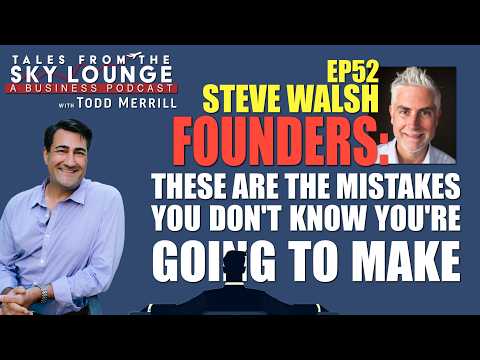
Founders: These Are the Mistakes You Don't Know You're Going to Make | Steve Walsh, Ep 52
Steve Walsh, an angel investor and startup advisor, shares lessons from 25 years building multi-billion dollar B2B divisions at Cox and Comcast before transitioning to helping early-stage founders. He discusses common founder mistakes, when to raise capital, the importance of customer validation before building product, and how he filters 6,000 conversations down to 69 investments through rigorous vetting and founder education.

Parallel Entrepreneurism: Shipping Startups Side by Side | Kirby Winters, Ep 50
Kirby Winters discusses launching multiple ventures simultaneously using AI-powered development, including Cyber Savi (a compliance automation platform), a vodka brand, and Unshucked (an oyster tracking app). He explains how agentic AI enables building production-ready software in weeks instead of years, the shift from consulting to outcome-based services, and strategies for selling cybersecurity compliance tools through MSP channel partners.